
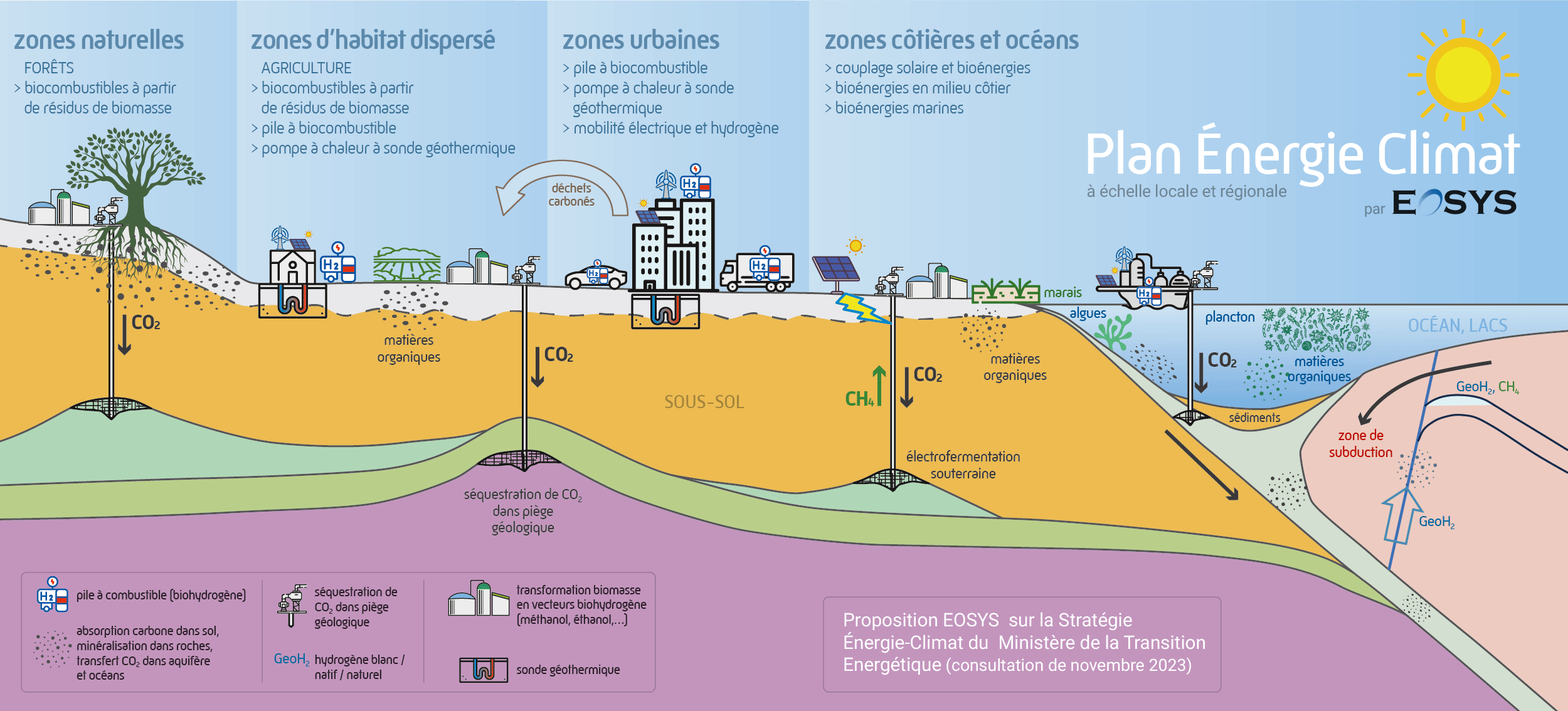
To halt the worsening climate crisis, what we urgently need to do today is to stop increasing the level of carbon in the atmosphere, and to organize our economic activities in such a way as to reduce it without delay.
This is the content of the proposal made by ACP Energies to the Minister of the Economy and Finance as part of the consultation organized at the end of 2023 by the former Ministry of Energy Transition.
In January 2025, this proposition becomes even more topical: the unabashed “drill, baby drill” doctrine of the new Trump administration will not be limited to the United States, and will undoubtedly have a knock-on effect in the rest of the Fossil Carbon Empire (Middle East, Africa, Latin America, China, India, Russia, Canada, Norway, etc.) We will therefore have to redouble our efforts to decarbonize the atmosphere if we want to limit the looming climate bombs.
ACP Energies proposal for climate: an Energy-Climate plan that returns Biosphere control to Life
Decarbonizing the atmosphere without delay has become a climate priority. The most effective and economical way to do this is to develop photosynthetic carbon capture on continents and in the oceans: encouraging the natural growth of forests and algae or plankton is a quick way to achieve this. Collecting part of it for bioenergy purposes in the form of biofuels is a simple and effective way of making these operations profitable.
We recommend that part of the surplus agricultural or forestry biomass (forest and wasteland maintenance to accelerate growth or minimize the risk of fire), domestic or industrial organic waste and rapidly rotating terrestrial or marine crops be dedicated to the production of methane (25% hydrogen content) or organic liquids with a high hydrogen content (alcohols, for example, with 13% hydrogen content). These gases and liquids would be distributed to end-users by adapting the existing oil and gas infrastructure. Fuel cells, using the hydrogen from these bioliquids or biogas, would be installed locally to supply users with electricity and/or heat. These technologies already operate in power ranges from the watt to several hundred kW, and this is a rapidly evolving technology that should be a priority for R&D in our country.
This would create energy chains with a conversion rate from primary energy to final electrical energy and/or heat that could be close to 1:1, which is advantageous given that the conversion rate from primary energy to final electrical energy is currently around 3:1 (national statistics) and that the national electric transport utility RTE hopes to bring it down to less than 2. 3 to 1 – a figure that is now required by law to be factored into building design in advance – by massively linking industrial solar and wind farms to the nuclear power plant network under the forthcoming Pluriannual Energy Planning Act.
In 2025, this proposition is even more topical: in 2024 Nature magazine has confirmed a 30% increase in the rate of photosynthesis , fuelling an accumulation of biomass all over the world. If not collected and managed in time, this will contribute to the eruption of uncontrollable mega-fires. We have just seen in January 2025 that these mega-fires are so uncontrollable that they have reached the heart of a mega-city such as Los Angeles.